Showing posts with label tech. Show all posts
Call to check on mobile network security

Mobile phone users are being encouraged to find out if operators are doing enough to keep their calls secret.
Security researchers have released tools that, they say, make it easy to see what security systems operators use to stop eavesdropping.
The researchers want to expose those operators that have not updated security systems to prevent others listening in.
The tools are based on an attack first demonstrated in late 2009.
"We do want people to go out and study how secure these networks are and to put pressure on the operators to improve," said Dr Karsten Nohl, the lead security researcher behind the project.
Dr Nohl gave a presentation about the tools, called Airprobe, and how to use them at the Black Hat hacker conference held in Las Vegas from 28-29 July.
"We've built tools that interface with cellular telephone communications," he said.
Continue reading the main story
“Start Quote
The practical risk to customers is very low and spreading fear and panic amongst mobile users is inappropriate and regrettable”
End Quote GSM Association
Most mobile calls are protected with an encryption system that uses a huge number of keys to stop eavesdropping. The vast amount of time it would take to try all the keys just to get at the contents of one call makes it effectively impossible to eavesdrop.
Dr Nohl said he, his colleagues and a few dozen others have found a way to shrink the amount of storage needed to hold a complete list of the keys and speed up the way to find the one that unscrambles a conversation.
Without these innovations the call cracking project would have got nowhere, said Dr Nohl.
"Just generating the key table would have taken 100,000 computer years and storing it would have taken 100 petabytes," he said.
Dr Nohl and his colleagues have squeezed the table into a format only two terabytes in size and produced algorithms that can look through it and find the right key in minutes.
Defeating such an attack would be easy for operators, if they have installed an appropriate software update, said Dr Nohl.
"We want to enable users to test whether their operator has installed the patch," he said. "If not they should call them up or send a letter."
Little evidence
The tools being shown off at Black Hat build on work done in late 2009 to generate the table of keys.
"What we are seeing is mobile phone hacking moving from an obscure sub-culture into a mainstream hacking movement," said Nigel Stanley, a mobile security analyst from Bloor Research.
Black Hat logo, Black Hat The Black Hat conference is all about practical attacks on secure systems
"When GSM security was originally designed call fraud was the issue, as was a concern that network suppliers would steal each other's customers," said Mr Stanley. "The thought that amateur hackers could break the code would have been laughable back then. Now it's a reality."
Commenting on the work, mobile phone industry body the GSM Association said: "Since 2007 reports of an imminent GSM eavesdropping capability by hacking groups have been common and operators have been monitoring this for some time."
The technical challenges of eavesdropping remained "considerable", said the GSMA.
"We have seen very little evidence that the hackers are able to overcome them," it added. It said that operators could quite easily change the way that calls were set up and handled in their networks to thwart eavesdropping.
It concluded: "GSMA remains convinced that the practical risk to customers is very low and spreading fear and panic amongst mobile users is inappropriate and regrettable."
Another ugly reminder to check your Facebook settings

You know that guy who just posted the personal details of 100 million Facebook profiles in an online downloadable file? He ain't Matthew Broderick in "War Games," Keanu Reeves as "Neo" or "The Girl with the Dragon Tattoo."
Sure, the dude wrote some code to access and aggregate user information through Facebook's directory , but he isn't a "cracker." He didn't even need to be a "hacker" to do it. Ron Bowes is just a security researcher who used a tool to quickly access all the profile info made readily available by Facebook users who — by either choice or chance — didn't lock it down.
If we take any lesson from this latest Facebook privacy brouhaha, it's one we should have already learned: Facebook isn't for people who don't wish to be known. Because here's the deal: Facebook has not now, nor will it ever, protect your information for you.
The thing to remember is that on Facebook, your wishes (or privacy settings, whatever) are by default, indexed for search engines. That's how Bowes was able to access and aggregate the 2.80 gigabyte file he uploaded to file-sharing website Pirate Bay. As in the Facebook statement, the information on this file "already exists in Google, Bing, other search engines, as well as on Facebook."
If users haven't properly understood and changed the default settings, information is available to be collected and aggregated by a security researcher like Bowes, or any unsavory character that may have already done the same and didn't bother mentioning it to the press.
"Facebook has been making so many changes, and every time those changes are made, the information is by default publicly available," said Nicole Ozer, technology and civil liberties policy director for the ACLU of Northern California.
"The 100 million people on that file make up one-fifth of Facebook. How many of those people haven't made a conscious choice, misunderstood a setting or even knew where to find it to change the default?" Failing to understand and change settings means people can inadvertently share private information that can be used in a way most users can't predict, Ozer says.
Game copiers for Nintendo DS ruled illegal in UK

A High Court has ruled that devices that allow gamers to play pirated video games are illegal in the UK.
The ruling specifically targets a range of popular devices which can be used to store and play copied games on the Nintedo DS handheld console.
The ruling says "game copiers" are illegal to import, advertise and sell in the UK.
The defendants - Playables Limited and Wai Dat Chan - had argued that they allow gamers to play home-made games.
"The mere fact that the device can be used for a non-infringing purpose is not a defence," read the ruling by Justice Floyd.
Related stories
* Nintendo 3DS: Newsbeat's sneak preview
* Crack down on US mod chip sellers
Nintendo said it was "pleased that the court was not persuaded by the defendant's arguments, claiming that game copiers are lawful, as they allow for the play of 'homebrew' applications".
"The court affirmed that game copiers first circumvent Nintendo's security systems before any non-infringing application can be played on Nintendo's handheld products," it said in a statement.
Playables Limited and Mr Chan did not respond to requests for comment.
This UK judgment follows a similar ruling in the Netherlands earlier in July.
Continue reading the main story
“Start Quote
The economic effect on Nintendo of the trade in these devices is substantial as each accused device can store and play copies of many Nintendo DS games”
End Quote Justic Floyd
The Hague District Court ruled that 11 Dutch online retailers acted unlawfully by importing and selling game copiers for use with Nintendo DS and modification chips for use with Wii.
Game copiers are designed to fit into the game cartridge of Nintendo's DS. Games can then be loaded from memory cards.
The chips circumvent the protection measures Nintendo has built into its DS consoles, enabling illegally pirated games to be downloaded online and stored on a chip.
Other gamers use them to store and load homemade games or, as they can hold multiple games, to store their entire collection of titles in a portable format.
They are sold for as little as £10.
The ruling said that the defendants had imported nine different devices on a "large scale".
"HMRC and Trading Standards have seized more than 165,000 game copiers intended for the defendants," it read.
"The economic effect on Nintendo of the trade in these devices is substantial as each accused device can store and play copies of many Nintendo DS games."
Broadband Britain rollout delayed by three years

The Culture Secretary Jeremy Hunt has blamed a lack of funds for the government's decision to delay the roll out of 2 megabits per second broadband in the UK.
The previous government had set 2012 as a deadline for network to be in place.
Mr Hunt said he did not think there was "sufficient funding in place" to meet that goal.
BT also warned that it will cost billions to get fast broadband to every part of Britain.
Steve Robertson, chief executive of BT Openreach, told BBC 5 live's Drive programme that the goal could not be achieved without around £2bn in public funding.
"Last month, I announced that we were supporting a universal service level of 2 Mbps as the very minimum that should be available," said Mr Hunt at an industry conference on 15 July.
"I have looked at the provision the Government had made to achieve this by 2012. And I'm afraid that I am not convinced that there is sufficient funding in place.
"So, while we will keep working towards that date, we have set ourselves a more realistic target of achieving universal 2 Mbps access within the lifetime of this Parliament," he added.
The government says industry must find ways to solve the problems.
But, other than £175m set aside from the Digital Switchover project, there is little new money available to fund these rollouts.
Mr Hunt told BBC News that the costs "had been scoped out" and he was confident "we should be able to deliver on our commitment."
"Obviously we are looking for solutions that allow extensions to superfast [broadband]. It would be a short-term fix if two megabits was the limit," he told BBC News.
He said the levy on the BBC licence fee used to fund digital switchover could be extended if necessary.
Mr Hunt is hosting a conference intended to mobilise companies on Thursday.
"Tomorrow I will bring together the key industry players who can help deliver this. I now need them to work together on solutions and tell us what we can do to help make this ambition a reality," he said.
Companies will have the chance to identify the current barriers to providing basic level broadband in rural areas as well as suggesting ways to make more use of publicly-owned networks, such as those connecting schools and hospitals.
Continue reading the main story
See the UK's notspots
BT said that public money to the tune of up to £2bn will be needed to put Britain at the top of the super-fast broadband league.
The money could come from local authorities, central government or the European Union.
The telco is spending £2.5bn installing fast broadband services to around two-thirds of UK homes.
But a significant number could be left in the slow lane.
"As a society we need to make our minds up about what is an essential element of our social fabric. Today not having broadband makes people feel deprived," said Steve Robertson.
The government is conducting a paper trial to work out how much it would cost to provide areas with slow broadband with faster services and will run pilots in three areas when the cheapest options emerge.
Research firm Point Topic estimates that around 2m homes are currently unable to get speeds of 2Mbps.
Some are in remote areas but others, such as Surrey village Ewhurst, are close to large towns.
Data needed
Continue reading the main story “
Start Quote
Today not having broadband makes people feel deprived”
End Quote
Steve Robertson
CEO, BT Openreach
Point Topic analyst Tim Johnson fears the government may have more work on its hands than it realises.
"These two million premises are not in clearly defined areas. The only way to reach the have-nots is to engineer a service upgrade for the whole area," he said.
That could bring the total number of houses needing upgrades closer to 5 million, which would cost the government more.
"There is a danger that a shortage of money and the search for clear wins will drive the two-meg minimum programme to concentrate on areas which are very remote," he said.
A few smaller firms, such as Rutland Telecom, are taking matters into their own hands and raising money from householders to improve broadband services in small communities.
But the process is made harder by BT's withholding of vital data.
In order to make decisions about how much it will cost to provide fibre to a community, firms need to know which homes are connected to which green street cabinet.
Rutland Telecom says BT has refused to hand over this crucial data.
BT denied this.
"We have a manual process for advising Rutland Telecom of the location of the street cabinets and Ofcom has confirmed that by providing this we are fully complying with our regulatory obligations," said a BT spokeswoman.
If more firms need such data in the future it may consider offering an automated system, the spokeswoman said.
Sorting out relatively minor regulatory issues such as this could make a big difference, thinks Tim Johnson.
"Obliging BT and similar companies to open their infrastructure data to the market is the single most effective measure the government could take to create the super-fast broadband network it wants," he said.
Mr Hunt said persuading companies such as Rutland to invest in broadband was "absolutely part of the process".
"We need a level playing field and have to make it easy for people to lay fibre in BT's or other's ducts," he said.
He said new legislation may be required to open up the ducts of electricity and water companies.
Search engine Bing gains market share

Microsoft's search engine Bing has shown impressive growth in its first year say industry experts.
Independent research suggests that Bing has cornered 12.7% of the market in the 12 months since it launched.
However Google has 62.6% and Yahoo 18.9%, according to figures from ComScore.
At a Microsoft summit to discuss Bing's progress, the search engine's executives admitted that there was "a long road ahead" for the site.
"There is something that we are doing that is clearly resonating but that said we are a low share player," Satya Nadello of Microsoft's online division told BBC News.
"We have barely gotten into double digits but we want this to grow into a significant business for Microsoft. It is a huge market where there is a significant profit pool that can be achieved.
"But we definitely wouldn't be in it if we were not going to play to win."
Continue reading the main story “
Start Quote
Microsoft has clearly said they are going to spend to be a player in this market”
End Quote
Ina Fried
Journalist, Cnet.com
Market research firm ComScore showed that Google's share of the US market stood at 62.6% through June, down from 63.7%. Yahoo was second with 18.9%, up from 18.3% in May.
"Google is very entrenched in the culture and in people's behaviour and that is a tough nut to crack," said Greg Sterling, contributing editor to industry website Search Engine Land.
"If Bing takes a long-term view they can make greater inroads than they have but I don't know if they can get beyond 30-40%. If they get to 20% plus that would be a big win for them."
'Momentum'
When Microsoft launched Bing in June 2009 it was billed as a decision engine with a "consumer friendly approach" that concentrated on popular topics like travel, entertainment, news, maps, weather and shopping.
"They seem to have some momentum and people are responding to their approach to search," said Greg Sterling.
Bing mobile has 23 million users in total. Mr Nadello said Microsoft had invested "significant dollars" in getting Bing on the search engine map.
"Microsoft has clearly said they are going to spend to be a player in this market," Ina Fried, senior writer for news website Cnet.com told BBC News.
"The big issue is still that this is a tough game when you come from behind. At the same time Google has lost a rival in the sense that Yahoo is mainly going to use Bing to drive its searches.
"The interesting question has to be is Google better off with one strong competitor or two weaker competitors?"
'Type less, do more'
Microsoft said that this year it has become more focused about its mobile strategy.
Just six months ago it launched a widget for the iPhone which has been downloaded by 4.3 million users in the US.
"It's clearly an area where growth in search is occurring and in terms of strategic importance, it is near the top for Microsoft," said Erik Jorgensen, senior vice-president for mobile.
He told reporters that the focus will be on accessing a user's location to deliver more relevant results, delivering a richer experience for shopping and integrating a user's social graph into results.
"Location is key," said Mr Jorgensen who also said Microsoft is focused on helping users "type less and do more".
"People drive themselves crazy trying to type on these mobile devices so the more we can understand what they are trying to do and provide an easier way to get to it through visual, voice and touch is a key insight into how mobile search is going to evolve," he added.
Facebook unveils child safety 'panic button'

Facebook has announced it will allow a "panic button" application on its social networking site.
The button, aimed at children and teenagers, will report abuse to the UK Child Exploitation and Online Protection Centre (Ceop) and Facebook.
Once installed, the application appears on their homepage to say that "they are in control online".
The launch follows months of negotiation between Ceop and Facebook, which initially resisted the idea.
Ceop, the government law enforcement agency tasked with tracking down online sex offenders, called for a panic button to be installed on social networking sites last November.
Bebo became the first network to add the button with MySpace following suit, but Facebook resisted the change, saying its own reporting systems were sufficient.
Pressure mounted on Facebook following the rape and murder of 17-year-old Ashleigh Hall by a 33-year-old convicted sex offender, posing as a teenage boy, who she met on Facebook.
Forty-four police chiefs in England, Wales and Scotland, signed a letter backing Ceop's call for a panic button on every Facebook page.
'Reassurance for parents'
The agreement to launch a child safety application is the culmination of months of negotiation between Ceop and Facebook.
Jim Gamble, Ceop's chief executive, said in a statement: "Our dialogue with Facebook about adopting the ClickCeop button is well documented - today however is a good day for child protection.
"By adding this application, Facebook users will have direct access to all the services that sit behind our ClickCeop button which should provide reassurance to every parent with teenagers on the site."
Facebook's head of communications in the UK, Sophy Silver, told BBC News that the new app would integrate reporting into both Facebook and Ceop's systems.
"Both sides are happy as to where we have got," she said.
"We still have the Facebook reporting system and by having a pre-packaged application that users play an active part in, you not only help keep them safe, it makes all of their friends aware too, and acts as a viral awareness campaign.
"Ultimately though, this makes for a safer environment for users and that's the most important part," she added.
In addition to the online reporting application, a new Facebook/Ceop page is being set up, with a range of topics that, it is hoped, will be of interest to teenagers, such as celebrities, music and exams. It will link these subjects to questions about online safety
On the iPad, finger painting goes digital
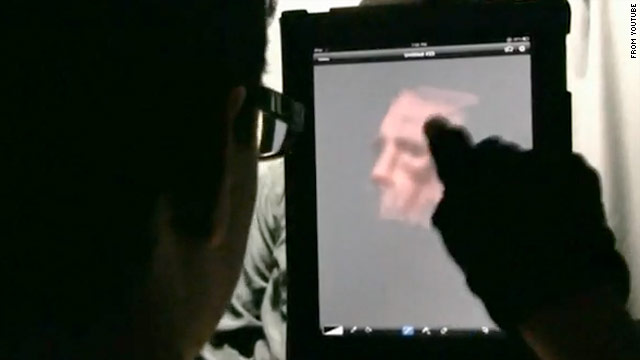
At 3 million sold, the Apple iPad seems to be swallowing traditional books, magazines and now finger painting. Actually, it's less a takeover than an evolution of our kindergarten practices.
Artist David Kassan has the internet going nuts with his new iPad art video. Recorded over the course of three hours, Kassan does an amazing painting of an older, bearded model using his thumb and forefinger. The session is compressed into eight minutes, and the results are fabulous. It's racked up about 580,000 views in a week.
Mainstream artists have been getting touchy-feely with their tech devices lately. For instance, a year ago The New Yorker commissioned Jorge Colombo to make its June 1, 2009, issue on the Apple iPhone. The result was an iconic New York hot dog vendor scene, and it proved popular enough for Colombo to do more New Yorker covers with the iPhone later in the summer.
Besides Apple, the commonality here is Brushes, a fairly cheap finger painting program for the iPhone, iPod Touch and iPad. Created by Steve Sprang, the iPhone/iPod Touch Brushes ran for a few dollars and became a bestseller. Apple gave Sprang early access to the iPad so the program could be featured as one of the device's launch titles. In fact, he became one of the main presenters at the big iPad announcement in March. The iPad version of Brushes costs a bit more now, $7.99, but it offers additional tools, a wider palette and, of course, a much larger screen.
What is fascinating is how earlier popular videos, like using iPhone Brushes to draw a sumptuous eye or a bulbous cameo, look as impressive as the iPad Brushes with a beautiful cartoon octopus or, well, doodles.
And now, in perhaps a natural evolution, Ten One Design announced a "pressure-sensitive" iPad app that will allow artists to use a wand to draw and sketch like a real pencil. The question is, How long will it be before kids are replacing watercolors and crayons with tablets and wands?
The opinions expressed in this commentary are solely those of Damon Brown.
Blizzard backs down over gamers using real names

Following a barrage of criticism, World of Warcraft publisher Blizzard has backed down on the need for gamers to use their real names on its forums.
The firm's about-face comes three days after saying it would introduce the feature as part of its Real ID product.
Blizzard said the intention was to cut down on "flame wars" and heated online arguments started to cause trouble.
Within 24 hours of announcing the plan, Blizzard received more than 1,000 comments, mostly critical.
Hours before the change of heart, there were around 50,000 comments stretching over some 2,500 pages.
"We've been constantly monitoring the feedback you've given us, as well as internally discussing your concerns about the use of real names on our forums," Mike Mourhaime, founder and chief executive of Blizzard wrote in an open letter on the company's forum page.
"As a result of those discussions, we've decided at this time that real names will not be needed for posting on official Blizzard forums."
REAL ID will still go ahead without the real names requirement and allow users to vote comments on the forum for World of Warcraft and Starcraft II up or down with low-rated posts slowly disappearing.
'Huge triumph'
The move has been described as a common sense one by those that cover the industry.
"Blizzard, like many firms, has been trying to figure out how to deal with the hateful flames that anonymous persons post by their thousands but getting gamers to use real identities wasn't the solution," said Dean Takahashi, lead writer with GamesBeat.com, an offshoot of the news website VentureBeat.
Critics of the real names plan feared it would chill free speech
"There is something to be said for being able to post anonymous comments especially when you want to say something truthfully but can't because you are worried about it say affecting your employment position or because of the backlash you might get," he told BBC News.
The Centre for Democracy and Technology called it a "huge triumph for gamers" given concern that the new policy could lead to identity theft, stalking, real-life harassment and encroach on privacy.
"Once again we have seen how a motivated group of users can take back their privacy by using the power of the internet to share a common concern, amplify the message and demand corporate action," said Sean Brooks, programme associate for the Centre.
Those very users who hit out at the move to end anonymity were just as quick to applaud Blizzard for its volte face.
Comments on the company's forum page ranged from "thanks for listening to us. We really appreciated the U-turn on Real ID forums" to simply "win".
One player who goes by the moniker Zwip, Ragnaros was more prosaic in their assessment of the publisher's move and wrote "elitism is the fall of man, To proclaim that you are a scrub is the realisation of true skill, for forever you are improving".
Google says China licence renewed by government

The Chinese government has renewed Google's licence to operate in China, the internet giant has said, ending a long-running stand-off between the two.
Google gave no details of the licence renewal.
There had been speculation China would revoke the licence after Google began redirecting Chinese users to its unfiltered search site in Hong Kong.
But last month, in a conciliatory move towards Beijing, Google said it would no longer automatically redirect users.
Analysis
Continue reading the main story
Rory Cellan-Jones,
Technology correspondent, BBC News
The battle between Google and the Chinese government appears to have ended in a score-draw.
Google can truthfully say that it has stopped censoring search results in China, fulfilling the promise it made at the end of last year. Its Chinese search business is effectively moribund in the country but it can continue to operate in other areas like music, so that Chinese citizens remain aware of its brand.
The Chinese government has made sure that its citizens cannot receive unfiltered search results because searches have to pass back from Hong Kong through the firewall where sensitive material can be removed.
A source at Google said: "We've had a lot of messages from China saying don't let Google go dark -we've managed to do that while staying true to our principles. "
Instead, Chinese users would be sent to a "landing page", which would send them to the Hong Kong site.
"We are very pleased that the government has renewed our ICP (internet content provider) licence and we look forward to continuing to provide web search and local products to our users in China," Google's lawyer David Drummond said in an e-mailed statement.
Google's share price rose 2% in early trading following the announcement.
On Thursday, Google boss Eric Schmidt said that he expected the Chinese government to renew the licence.
'Cyber attack'
Google has had a long history of run-ins with the Chinese authorities, but without a licence granted by Beijing, it cannot operate in China.
"Our operations in China are completely at the discretion of the Chinese government," Mr Schmidt has said.
In January, Google said it might pull out of China following what it called a "sophisticated" cyber attack originating from the country.
The attacks targeted the e-mail accounts of Chinese human rights activists, along with the computers and infrastructure of Google and several other US firms.
GOOGLE CHINA TIMELINE
Continue reading the main story
January 2006: Google launches in China
March 2009: China blocks access to YouTube
June 2009: China introduces filtering software on all new PCs
January 2010: Google says it may pull out of China after cyber attacks
January 2010: China denounces US criticism of its internet controls
March 2010: China's state media attacks Google for close ties with the White House
March 2010: Google says will automatically redirect China customers to uncensored Hong Kong site
June 2010: Google says China customers now have to actively click on Hong Kong site
July 2010: China renews Google licence
Following the threat to withdraw, some passers-by laid flowers outside Google's offices to thank the company for standing up for its principles.
The US government even issued a statement saying it was "disappointed" that Google and China had not been able to resolve their differences.
'Issues remain'
The licence renewal is key to Google. Losing business in China, which already has more internet users than any other country despite relatively low penetration, could harm the company's future growth prospects.
Analysts welcomed the renewal, but warned that fundamental differences between Google and China remained.
"It is good news for the Chinese consumer and good news for the Chinese internet industry that Google is still available in the country in some shape or form," said Ted Dean at Beijing-based business advisory firm BDA.
"But many of the issues around why Google shut down its Chinese search page in the first place are still there."
Elinor Leung, at investment firm CLSA in Hong Kong, went even further, arguing that "this doesn't really change anything about Google's position in China. The redirection to its Hong Kong site is ongoing so it is the same problem as before".
Solar-powered plane lands safely after 26-hour flight

An experimental solar-powered aircraft launched on Wednesday has landed safely in Switzerland after successfully flying through the night.
The feat is a step toward the makers' aim of circling the globe using the power of the Sun to fuel the plane.
The aircraft used super-efficient solar cells and batteries to stay in the air after the Sun's rays had faded.
The plane touched down at an airfield about 30 miles (50 km) from the Swiss capital Bern at 0900 (0700 GMT).
The plane landed at Payerne airport after a total flight time of 26 hours.
During the flight it reached a height of 8,700 m (28,543 ft).
Assistants rushed to stabilise the experimental aircraft as it touched down, ensuring that its huge 63m (207ft) wingspan did not scrape the ground and topple the plane.
It is the longest and highest flight recorded by a solar-powered plane.
The four-engine aircraft was steered by Andre Borschberg, a former fighter jet pilot from Switzerland.
The plane has 12,000 solar cells arranged on its wingspan which collected enough energy to power the plane for the flight.
'Perpetual flight'
Previous flights of Solar Impulse have included a brief "flea hop" and a longer airborne test earlier this year. But this week's attempt was described as a "milestone" by the team.
The designers, the Solar Impulse team led by Mr Borschberg and fellow aviator Bertrand Piccard, say that this proves that a plane can be kept in the air around the clock.
Continue reading the main story
Nothing can prevent us from another day and night, and the myth of perpetual flight
Bertrand Piccard
Solar Impulse
Solar 24-hour test flight starts
"It's the first time ever that a [manned] solar airplane has flown through the night," Mr Piccard told journalists.
"That was the moment that proved the mission was successful, we made it."
The plane emerged from the darkness of night with three hours power remaining in its batteries, more than had been expected.
"Nothing can prevent us from another day and night, and the myth of perpetual flight."
The team will now build a new, more advanced, model of the plane.
Nintendo 3DS wins E3's Best of Show
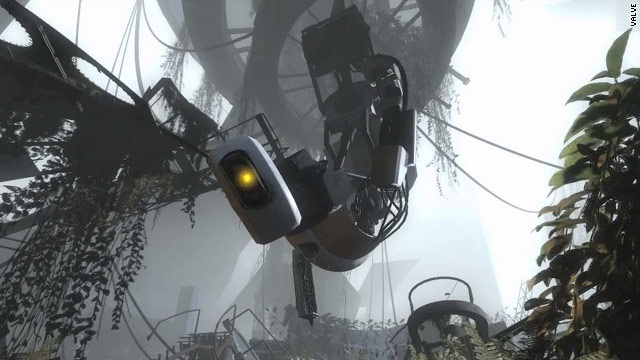
If you are a video gamer or know a gamer, here are the games and consoles that should be must-haves in the coming months.
The Nintendo 3DS, a hand-held console that allows games to be displayed in 3-D without the use of special glasses, took the Best of E3 2010 award from a panel of game reviewers.
Announced Tuesday, the Game Critics Awards honored video games and game consoles displayed at the Electronic Entertainment Expo last month in Los Angeles, California.
In addition to the Best of Show award, the 3DS also won Best Hardware. It beat out Microsoft's Kinect motion sensor, which detects a player's movements without the use of a controller; Sony's Move system, a wand-like controller that mimics a player's hand and arm movements; and two "Rock Band 3" instrument controllers.
"Rage" (id Software/Bethesda), a first-person shooter/racing game, took home three awards: Best Console Game, Best Action Game and a Special Commendation for Graphics. Not much is known about the game itself, but critics were wowed by its look and feel from trailers shown at E3.
"Portal 2" (Valve) and "Dance Central" (Harmonix/MTV Games) each won two awards for their entries at E3. "Dance Central," a game that will use the Kinect controller, won Best Original Game and Best Motion Simulation Game.
"Portal 2," a sci-fi game in which the player must battle a murderous computer, won Best PC Game and Best Action/Adventure Game.
"Assassin's Creed: Brotherhood," "Civilization V," "God of War: Ghost of Sparta," "Marvel vs. Capcom 3: Fate of Two Worlds," "NBA Jam," "Need for Speed Hot Pursuit," "Rock Band 3" and "Star Wars: The Old Republic" all took home individual awards.
For the complete list, click here.
The Game Critics Awards are decided by representatives from 31 gaming publications after the E3 convention closes. The first Best of Show award was presented in 1999 to "Freelancer," a space trading and combat simulation game. However, "Freelancer" wasn't available to the public until 2003.
Deep-sea mysteries: Why drilling in 'inner space' tests human limits
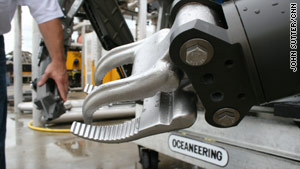
Behind each video feed of oil billowing out of the bottom of the Gulf of Mexico is a robot about the size of a minibus built at an industrial center in this Louisiana oil town.
The robots, which go by the name Millennium, are constructed as if they're on a voyage to another world -- one that's "harsher than space," says Mark Campbell, the manufacturing manager at Oceaneering International's production site.
This may come as a surprise since the oil cam produces images so clear they look like they could have been filmed at the bottom of a neighborhood pool. But keep in mind that these robots -- which hover like confused cuttlefish in front of the busted pipe 24 hours a day -- navigate a world that's 5,000 feet below the surface of the ocean.
CNN Live: Underwater view of leak site
It's pitch black, just barely above freezing and the pressure under a mile of water is about 10 times as intense as that in an aerosol canister. People would be flattened and killed at such depths.
"We're the eyes," says Campbell, who worked on a professional race-car team and in the aerospace industry before turning his eyes to the deep ocean, which he sees as a much bigger challenge. "There's no other way to see what's going on down there."
The challenges of working in the deep sea -- and our apparent lack of understanding in how to do so -- have been thrust into the national spotlight in recent weeks, as the country debates the merits of drilling for oil in increasingly deeper waters.
Pros, cons of drilling moratorium
Video: Oil-skimming vessel yet to prove itself
Video: Where is the oil?
Video: Mississippi cleaning up small tar balls
President Obama's moratorium on new deepwater oil wells, which a judge overturned and the administration now is appealing, has only stoked the debate.
Administration officials have argued the fact that we know so little about the deep ocean -- and what exactly caused the Deepwater Horizon oil rig to catch fire on April 20 -- means we have no business punching new holes in great depths of the ocean floor for at least six months until we figure out a safer way to do it.
Others say the industry has a sterling 30-year safety record -- the BP oil disaster aside -- and we must search for oil in deeper waters because supplies have been exhausted on land and in shallower waters. As we did in our quest for flight or the race to space, people must forge ahead into new frontiers even if there's some risk, they say.
Perhaps the only thing that is clear is this: The mysteries of the deep still confound all who would go there.
Mysteries of 'inner space'
What we know of the ocean's dark depths is secondhand knowledge.
Technology firms like Oceaneering, oil companies and marine biologists have been trying to understand the deep for decades. But efforts have been relatively limited. Marine biologists say we have explored less than 1 percent of the ocean floor, mostly by using remotely operated vehicles such as the Millennium, or by plunging into the abyss in metal spheres called submersibles.
These efforts have led to some revelations about life in the deep sea -- the first of which was that life actually exists down there. But we still know less about the deep than we do about parts of outer space and the dark side of the moon, scientists say.
People who study the deep refer to it as "inner space," because it's part of a world that's so alien. "With all the rovers and things on the moon," says Lisa Levin, a professor of biological oceanography at the Scripps Institution of Oceanography, "I think it's reasonable to say we've seen more of the moon than the deep sea."
Because so little of the ocean floor has been charted, scientists tend to find something new each time they visit.
"Every time we go, we discover something new and astonishing: Fluorescent sharks, new types of bioluminescence, new types of animals -- you name it," says Edie Widder, CEO and senior scientist at the Ocean Research & Conservation Association, a nonprofit based in Florida. "It's pretty incredible and beautiful really."
Her favorite discovery, a 6-foot-tall squid, was "so new to science that it couldn't even be classified," and still hasn't been, she says.
About a century ago, scientists assumed that nothing lived at the bottom of the ocean because, at depths greater than a couple hundred feet, no sunlight penetrates the water. Sunlight, of course, is the basis for the food chain on land and in shallow water.
More recently, researchers have been finding increasingly diverse life in the deep, including communities of organisms -- from tubeworms to coral -- that live off spurts of icy methane gas that shoot up through the ocean floor.
"We used to think it was fairly monotonous and homogenous and quiet and muddy and dark -- and it turns out that that's not exactly true," Levin says.
Fish and other deepwater organisms live off "marine snow," the name scientists give to debris that falls from the shallow ocean, where light supports plant growth. When scientists do travel to the deep, in thick metal containers that become so cold that travelers have to bring several layers of clothes, this "snow" glows in the otherwise pitch-black ocean, making it look like they're flying through outer space.
"It's almost like the sky full of stars," says Miriam Kastner, a distinguished professor of Earth sciences at Scripps Institution of Oceanography.
The unfolding scientific mysteries of the deep are reason enough for some marine biologists to say that we should not be drilling for oil there.
We just don't understand the system well enough, they say.
"We have a tendency to wreck things before we even discover them," Levin says.
Robots are being used to fix the leaking pipe. They can work at depths of 5,000 feet, unlike humans.
Robots are being used to fix the leaking pipe. They can work at depths of 5,000 feet, unlike humans.
Robot proxies
The cold and high-pressure environment of the deep makes learning about the bottom of the ocean -- much less working there -- a challenge.
Oceaneering International, the company that makes the robots that are filming the oil spill and have tried, in vain, to fix BP's leaking pipe, says its technologies for working in the deep are state of the art. But Campbell, the manufacturing manager, is quick to acknowledge that Oceaneering's deepwater ROVs were designed to support drilling operations -- not repair unprecedented blowouts such as the one in the Gulf.
No one anticipated such a catastrophe, he says.
A closer look at how these underwater robots work reveals some of the many difficulties oil companies and scientists face when working in deep waters. Simple tasks -- like tying a rope in a knot or putting together a nut and bolt -- might take an ROV such as the Millennium 30 minutes in deep water, Campbell says.
A human could do similar tasks in seconds. But we can't dive to 5,000 feet. Federal regulations prohibit recreational scuba divers from going below 130 feet. Dive inspectors have been known to go significantly farther, but they have to "decompress" for several days in pressurized chambers after working at depths of several hundred feet, Campbell says. Otherwise, the oxygen would separate from their blood and they could die.
"Pilots" control Oceaneering's camera-toting underwater robots from ships a mile above, on the surface of the water. If the robots were filming the rings of Saturn, they would be able to send back their footage through space via relatively low-power radio frequencies. But because they're at the bottom of the ocean, and the water would garble those signals, the robots are tethered to the boat by miles of "umbilical cord."
The cable somewhat restricts the movements of the robots. And bringing them up to the ship and sending them back down can take hours.
Operators use hypersensitive joysticks to control the Millennium's movements. A metal arm, which looks like it might belong on a Velociraptor, juts out of the front of the Millennium's rectangular body. Different types of mechanical hands can be placed at the end of these arms. One model is good at holding pipes. Another can pinch flat surfaces, which allows it to hold wrenches and other human tools.
Mark Campbell, manufacturing manager at Oceaneering, says underwater ROVs are equipped to tackle many tasks.
Mark Campbell, manufacturing manager at Oceaneering, says underwater ROVs are equipped to tackle many tasks.
Campbell says the robots are versatile, and the operators are "top guns" who, in the case of the BP oil disaster response, each has at least 12 years of piloting experience.
But, again, there are limits to what these robots can do.
One ROV got a saw lodged in the side of the leaking riser pipe in early June, for example, causing BP to rethink its strategy for trying to stop the gushing leak.
Ian MacDonald, an oceanographer at Florida State University who has worked with remotely operated vehicles in his research, says the robots can't replicate human dexterity.
"You pass a lot of agonizing hours watching somebody try to do something at the end of a cable a mile long -- down in the deep, dark ocean," he says. "They just need to turn one little bolt and it can take hours, literally, to do something that would take a few seconds to do on the land with human hands."
Things get murkier still when oil companies drill deep below the surface of the ocean floor, since even robots can't go down there to see what's going on.
But some petroleum industry experts maintain the technology for drilling deepwater wells is safe. "It is a challenge. It is a frontier area. I don't want to diminish that," says David Dismukes, associate director of Louisiana State University's Center for Energy Studies. "But to suggest that it is reckless is not entirely accurate."
Over the years, wells have plunged deeper into the Gulf in search of oil. The Deepwater Horizon rig, which started the Gulf oil disaster, was drilling in 5,000 feet of water. A Shell rig called Perdido, which claims to be the deepest in the world, drills for oil more than 8,000 feet below the sea. Both rigs plunge pipes thousands of feet further into the Earth's crust.
Eric Smith, associate director of the Tulane Energy Institute, says the BP oil disaster shows that the industry knows how to drill in deepwater, but doesn't have the technology to fix problems if something goes awry.
"We're designed to work well in terms of the normal -- if there is a normal -- drilling mode," he says. "But what's shown up is that killing wells in deep water is more complicated than killing them on land or in shallow water.
"We always kill the well, it's just how long is it going to take to do it," he says.
Oceaneering has planned improvements to its ROV designs, and is updating the robots in the Gulf today with new equipment all the time, Campbell says. One prototype lets ROV pilots see the area they're working in with a three-dimensional computer monitor. On 2-D screens, it's difficult to see where the robots are, relative to other deepwater objects, he says.
"It's always better to send a human down if possible because humans see in 3-D -- ROVs see in 2-D," he says. "Sometimes you just can't eliminate the human interface."
The company also is trying to improve the dexterity of the robots' hands.
Each ROV already costs between $3.5 million and $6 million, he says. They weigh about 8,000 pounds on land, or twice as much as a small car. Oceaneering leases the machines to oil companies, including BP, but sends its own crew to drive the complicated robots from boats on the surface of the water.
Walking through Oceaneering's warehouse full of boxy robots on stilts, Campbell says people don't realize how far these machines have to travel to monitor the oil that's gushing into the Gulf every day -- or how well-equipped they must be.
The reality is this: As common as the live video feeds from the bottom of the ocean have become, the robots that get those images might as well be on another planet.