Showing posts with label asia. Show all posts
Australia bushfires report calls for response changes

A report into Australia's worst bushfires has called for sweeping changes to the way the authorities respond to natural disasters.
Some 173 people were killed when fires tore across Victoria in early 2009.
Over 155 days a royal commission heard complaints about a lack of official information from a string of witnesses.
The report says authorities should build shelters in vulnerable areas and devise a full evacuation plan. Victoria has vowed to act swiftly on the report.
Related stories
* Audio slideshow: Fleeing the flames
* Eyewitness stories: Australia fires
* Creating the perfect firestorm
The state government says it will make a decisive response to the sharp critique of its actions.
Poor official information about the speed and direction of the fires was a major complaint among the more than 400 witnesses who gave evidence to the commission.
They said the emergency system simply fell apart under pressure.
Vulnerable communities
The 2009 Victorian Bushfires Royal Commission was established by the federal Australian government to investigate the causes and responses to the bushfires, which swept through the state in January and February that year.
The panel, which was headed by a former Supreme Court judge, also examined the individual circumstances of each of the deaths.
One of the most significant of the 67 recommendations in the report is the call for an overhaul of the so-called "stay and defend or leave early" policy, which has been a mainstay of fire management across Australia.
Continue reading the main story
“Start Quote
I feel the full weight of responsibility to make sure that we get our response to the commission's report right to make sure we make our state as safe as possible”
End Quote John Brumby Premier of Victoria
Many of the people who died acted on official advice that if they could save their house they could save themselves.
The advice was only withdrawn after "Black Saturday" on 7 February 2009, when hundreds of fires started north of Melbourne as temperatures soared to 48C and strong winds blew in from the interior.
Rather than abandoning the "stay or go" policy, the commission recommends adopting a hybrid model that includes strengthening public warnings, providing designated community refuges and bushfire shelters in areas of high risk, and developing plans for emergency evacuations.
The report also says that leadership during the crisis was "wanting", and recommends appointing a fire commissioner in each state.
Victoria's former police chief commissioner, Christine Nixon, was criticised for going out to dinner on Black Saturday and being out of touch for three hours despite being charged with co-ordinating the emergency response. She resigned as head of the Bushfire Recovery Committee earlier in July.
The commission says Ms Nixon, as well as former Country Fire Authority head Russell Rees and the department of the environment's chief fire officer, Ewan Waller, "did not demonstrate effective leadership in crucial areas" by ensuring that "prompt and accurate warnings were issued to communities in the path of the fires".
Burnt-out houses and cars in Kinglake (8 February 2009) Many who survived Black Saturday are too afraid to return to the fire-zone
The commission also wants the state government to roughly quadruple the amount of controlled burning it undertakes, and develop a voluntary scheme to acquire land in areas of unacceptably high bushfire risk. It also recommends that ageing power lines be replaced with underground cables.
Jean Howard, a resident of Kinglake, one of the communities worst-affected by the bushfires, told the BBC before the report's publication that she hoped the report would offer constructive advice rather than simply condemning those in authority.
"I know people are going to be blamed for it but... I don't think anybody can be to blame because it was a day that nobody had ever lived through or seen before, and nobody could have prepared for a day that that was."
Victoria Premier John Brumby said the state government would undertake a community consultation process on the report before responding.
"As premier I feel the full weight of responsibility to make sure that we get our response to the commission's report right to make sure we make our state as safe as possible," he told reporters.
"The people of our state want the opportunity to have some input."
The BBC's Phil Mercer, in Sydney, says many Australians who survived Black Saturday have been too afraid to return to the fire zone, while those who have come back to start again believe that more needs to be done to protect their vulnerable communities from nature's fury.
Floods wash barrels of chemicals into China river

Rescue teams in north-east China are working to retrieve 3,000 barrels of chemicals washed into a major river, state media say.
Severe floods washed the barrels, from two chemical storage facilities, into the Songhua river in Jilin city.
Around 400 barrels have been recovered so far by workers at eight stations on the river.
Water quality was being checked and no chemicals had yet been found in the water, state media said.
Several parts of China have been hit by flooding in recent weeks, amid the worst seasonal rains in a decade.
Elsewhere in Jilin, 30,000 people in the town of Kouqian were said to be trapped by floodwaters after a reservoir and two rivers burst its banks.
Panic-buying
The Songhua River is the largest tributary of the Heilongjiang river, also known as the Amur river in Russia, on the China-Russia border.
Map
Xinhua news agency said that a total of 7,000 barrels from the storage facilities of two chemical plants had been washed into the river.
Four thousands of the barrels were empty, the agency said. The remaining 3,000 contained flammable chemicals, it said.
Water supplies in the city of 4.5 million people were briefly suspended and panic-buying reported as residents stocked up on bottled water.
But by Thursday morning water supplies had been mostly restored, reports said.
Water quality in the river was being monitored at seven stations, Xinhua news agency said.
"Some residents are worried, but we have yet to find any leaks in the barrels of chemicals, so they should not be worried about their water quality," an official with the Jilin Water Bureau, who did not want to be identified, told AP news agency.
Russian authorities were also checking the water in the Heilongjiang river (the Amur river), a report on Russian television said.
Five years ago a chemical spill in the Songhua river left the city of Harbin and its 3.8 million residents without water for five days.
Flooding traps 30,000 in Chinese town

Flooding in northeastern China has stranded 30,000 people in one town and washed 1,000 barrels of explosive chemicals into a river, reports say.
In Kouqian town in Jilin province, residents were trapped when a reservoir and two rivers overflowed following torrential rain.
In Jilin city itself, containers of explosive fluid from a chemical plant were washed into the Songhua river.
China is facing its worst flooding in more than a decade.
Weeks of heavy rain have swollen rivers and caused damage, landslides and bridge collapses across a swathe of the country.
According to state media, 928 people have died because of the seasonal bad weather and another 477 are missing.
Continue reading the main story
Map
* In pictures: Flooding in China
More than 200 rescue workers have been sent to Kouqian, where tens of thousands of residents are reportedly trapped after the Xingshan reservoir and the Wende and Songhua rivers burst their banks.
Chinese media reports said houses and buildings were under water, and 80 people were trapped in a train station surrounded by water.
In Jilin city, emergency teams were trying to recover barrels of explosive chemicals washed into the river.
Environmental officials were said to be monitoring the water quality in the river.
Further to the south, in Wuhan city in Hubei province, workers were sandbagging river banks ahead of possible flooding where the Yangtze and Han rivers converge.
Three Gorges test
Early on Wednesday, the massive Three Gorges Dam on the Yangtze river faced its second test of the season, as floods pushed the water in its reservoir to near capacity.
Advertisement
Vast amounts of water have been released from behind the Three Gorges Dam in recent days
Engineers said the water level rose to 158m (518ft) at 0800 local time (0000 GMT) on Wednesday. The maximum capacity is 175m.
Flow rates hit 56,000 cubic meters per second - a new high for the dam but lower than last week's peak of 70,000 cubic metres per second on the upper levels of the Yangtze, Xinhua news agency said.
Authorities have warned communities downstream to prepare for rising water levels as the dam's huge spill gates release torrents of water.
Amnesty warns of healthcare crisis in North Korea

North Korea is failing to provide the most basic healthcare needs for its people, Amnesty International warns.
An investigation by the human rights watchdog found barely functioning hospitals, poor hygiene and epidemics made worse by widespread malnutrition.
Many people were also too poor to pay for treatment, the report citing North Koreans and health workers said.
Pyongyang spends less than $1 (£0.65) per person on healthcare a year, World Health Organization figures show.
Related stories
Life inside the North Korean bubble
Defectors tell of life in North Korea
Amnesty's report, The Crumbling State of Health Care in North Korea, is based on interviews with more than 40 North Koreans, who left the country between 2004 and 2009.
Health professionals who work with North Koreans were also consulted.
Starvation
Pyongyang says it provides free healthcare for its people, but witnesses told Amnesty they had had to pay for all services for the past 20 years.
One 20-year-old woman from North Hamgyeong province said: "People don't bother going to the hospital if they don't have money because everyone knows that you have to pay.
"If you don't have money you die," said the woman, who left North Korea in 2008.
Another man said that hospitals had no medicine and that if someone needed treatment, they had to go to the market and buy the drugs needed for doctors to administer.
Poor hygiene at medical facilities and a dire lack of medicines were threatening the lives of many, Amnesty warned, with people routinely trading cigarettes, food and alcohol for treatment.
Continue reading the main story
“
Start Quote
It is crucial that aid to North Korea is not used as a political football by donor countries”
End Quote
Catherine Baber
Deputy director, Amnesty Asia-Pacific
A 56-year-old woman told Amnesty that her appendix was removed without anaesthetic.
"The operation took about an hour and 10 minutes. I was screaming so much from the pain - I thought I was going to die.
"They had tied my hands and legs to prevent me from moving."
North Korea faces critical food shortages following famine in the 1990s which killed up to one million people and relies on international aid.
A botched currency re-evaluation in 2009 almost doubled the price of rice overnight, and one non-governmental organisation cited in the report said thousands of people starved to death in January and February this year in one province alone.
Amnesty reports that North Korea is still battling a tuberculosis epidemic, which is being aggravated by widespread malnutrition.
"The North Korean people are in critical need of medical and food aid," said Amnesty's deputy director for Asia-Pacific, Catherine Baber.
"It is crucial that aid to North Korea is not used as a political football by donor countries."
Politically the North finds itself isolated - it has withdrawn from international talks over its controversial nuclear programme.
UN sanctions were tightened last year after Pyongyang's nuclear and missile tests.
North Korea has also suspended all ties with Seoul in the wake of the attack on a South Korean warship in March that left 46 sailors dead.
International investigators say a North Korean torpedo sank the ship, but Pyongyang has rejected this.
Australia and Indonesia discuss refugee processing

Australian Foreign Minister Stephen Smith is on his way to Indonesia for talks about plans for a regional refugee processing centre.
Australia has proposed setting up an asylum seekers' centre in East Timor.
But Indonesia has expressed concern that this could attract more refugees to Indonesian waters, and East Timor has not agreed to the plan.
Australia wants to deter asylum seekers, many from Sri Lanka and Afghanistan, from sailing to Australia.
Many of them have been caught in Indonesian waters, and Indonesian authorities have pointed out that Indonesian West Timor and independent East Timor share a porous land border.
Regional solutions?
The Australian foreign minister will meet with his Indonesian counterpart Marty Natalegawa in Jakarta.
Mr Smith told Australian media that a regional processing centre would encourage asylum seekers to focus on one destination in the region.
"I think when we sit down with not just Indonesia, but other countries in the region the policy rationale for a regional processing centre is to undercut the incentive for secondary movement, particularly to undercut the incentive for secondary movement by boat across the high seas in dangerous circumstances," he said.
Australia has also said it remains in talks with East Timor over the plan, despite a rejection by the country's parliament.
"Our focus is on discussions with the East Timor government, and the East Timor government continues to confirm to us that it is open to the dialogue about the regional processing centre, and we're in that dialogue now," new Prime Minister Julia Gillard told parliament on Tuesday.
Meanwhile, the Pacific territory of Nauru has offered to host a processing centre again, as it did under a previous Australian government in what was called the Pacific solution.
Immigration is highly controversial in Australia, where an election is expected to be called shortly.
Asylum-seekers are currently processed at Christmas Island in the Indian Ocean, but this centre is overwhelmed and others have had to be reopened on the Australian mainland.
The BBC's Indonesia correspondent Karishma Vaswani says Indonesia and Australia have struggled to solve this issue in the past.
Last year they failed to sign a wide ranging agreement on asylum seekers which had been dubbed by the media as the Indonesian solution.
Official figures show that about 2,982 asylum-seekers were intercepted on their way to Australia this year until 19 May.
Japan PM rules out snap poll after election setback

Japanese Prime Minister Naoto Kan has ruled out calling a snap election following his party's poor performance in upper house polls.
Mr Kan, who has only been in office for a month, urged the Japanese public to give his administration a chance.
His party won just 44 seats - well short of its goal of 54.
The poll - which leaves the ruling Democratic Party of Japan without a majority in the upper house - was seen as a referendum on its 10-month rule.
A total of 121 seats, half of the upper house, were being contested in the polls.
The DPJ held 62 seats not being contested, and its 44 wins leave it short of the 122 majority needed.
Its tiny ally, the People's New Party, won no seats in Sunday's election.
The DPJ still has a majority in the more powerful lower house which it can use to force legislation through parliament, but its ability to govern effectively has been challenged.
Mr Kan has said he will not resign and late on Monday ruled out calling an early poll.
"Only about one month has passed since the launch of my administration and I want the chance to firmly manage this administration with the people of Japan watching," Reuters news agency quoted him as saying.
Financial fears
The DPJ came to power last August, ending half a century of dominance by its main rivals, the conservative Liberal Democratic Party, which won 51 seats.
JAPAN'S UPPER HOUSE
Continue reading the main story
Known as the House of Councillors
Has the power to block bills, except treaties and budgets
Vote often seen as a referendum on ruling party
121 of 242 seats were contested
DPJ predicted to win only 44 of seats contested
Poll blow raises economy fears
Mr Kan succeeded Yukio Hatoyama, who resigned abruptly after only nine months in office amid funding scandals and a row over an American military base.
The upper house election campaign was dominated by the prime minister's suggestion that Japan needed to discuss the possibility of an increase in sales tax - an issue that has divided voters.
Sales tax currently stands at 5%, but Mr Kan had suggested raising this as high as 10%.
Mr Kan said the country had to make sure it avoided financial collapse.
"Japan's economy is 20 to 30 times bigger than that of Greece and its public debt is huge, so no country in the world could rescue Japan," he said on Friday.
Japan has been borrowing money for two decades, trying to bring its economy out of stagnation.
The BBC's Roland Buerk in Tokyo says that what was at stake was whether the prime minister would be able to build a stable political base to tackle the massive national debt.
Our correspondent says Mr Kan must now look for allies among smaller parties and the result could leave the prime minister vulnerable to leadership challenges from within his own party.
Upper house vote tests Japan PM Naoto Kan

Japan is voting in upper house polls being seen as a referendum on the 10 months of rule by the Democratic Party of Japan (DPJ) led by PM Naoto Kan.
He told supporters on Saturday that Japan had to avoid financial collapse.
Mr Kan came to office last month and polls suggest the DPJ and its allies may lose their majority in the house.
A poor result could force him to seek new coalition partners, and may even see Mr Kan ousted by his party, says the BBC's Roland Buerk in Tokyo.
The DPJ came to power last August, ending half a century of dominance by its main rivals, the conservative Liberal Democratic Party.
Mr Kan succeeded Yukio Hatoyama who resigned abruptly after only nine months in office.
Polls close at 2000 (1100 GMT), with exit polls expected to indicate likely results immediately after that.
Sales tax row
In Sunday's poll, 121 seats, half of the upper house, are being contested.
Currently, the DPJ and its coalition ally, the People's New Party, control 122 seats. But opinion polls suggested the DPJ would lose some of its seats.
The campaign has been dominated by the prime minister's suggestion that Japan needs to discuss the possibility of an increase in sales tax - an issue that has divided voters, says our Tokyo correspondent.
JAPAN'S UPPER HOUSE
Continue reading the main story
Known as the House of Councillors
Has the power to block bills, except treaties and budgets
Vote often seen as a referendum on ruling party
121 of 242 seats are being contested
Ruling DPJ currently has 54 seats
Main opposition party LDP has 38
Polls predict DPJ may lose seats
Around 104 million Japanese are eligible to vote. More than 9.5 million voters had already cast early ballots on Sunday morning.
There were mixed messages from voters leaving the polls.
Junko Yoshimizu, 68, who cast her vote for the DPJ, said in Tokyo: "I still have hope for them and as such I want to give them a bit more time."
But Akira Ono, also 68, said after casting his vote: "They weren't as good as I was expecting and so I'm somewhat disappointed."
Addressing supporters in Tokyo as the campaign drew to a close, Mr Kan said the country had to make sure it avoided collapse.
"Japan's economy is 20 to 30 times bigger than that of Greece and its public debt is huge, so no country in the world could rescue Japan," Mr Kan said.
Japan has been borrowing money for two decades, trying to bring its economy out of stagnation.
The new government has seized greater control of policy-making from the powerful bureaucracy, our correspondent says.
But it has performed less well tackling Japan's big problems - the ageing population and the vast national debt.
Funding scandals and a row over an American military base brought down Mr Hatoyama.
North Korea welcomes UN statement on Cheonan sinking

North Korea has hailed as a "victory" a UN Security Council statement that condemns the sinking of a South Korean warship but avoids blaming Pyongyang.
The statement expresses "deep concern" over the finding by a South Korean-led inquiry that a North Korean torpedo had struck the Cheonan, killing 46 sailors.
But it also "takes note" of Pyongyang's insistence that "it had nothing to do with the incident" in the Yellow Sea.
Correspondents say the omission of blame helped ensure China's support.
The unanimous statement said the "attack" on 26 March had endangered "peace and security in the region and beyond".
"In view of the findings of the Joint Civilian-Military Investigation Group led by the Republic of Korea with the participation of five nations, which concluded that the Democratic People's Republic of Korea was responsible for sinking the Cheonan, the Security Council expresses its deep concern," it said.
The statement also praised South Korea's government for the "restraint" it had shown since the incident and called for "appropriate and peaceful measures to be taken against those responsible".
Naval exercise
North Korea's permanent representative to the UN told reporters in New York afterwards that the text was a "great diplomatic victory".
"From the beginning of the incident we have made our position very clear that this incident has nothing to do with us," Sin Son-ho said.
Continue reading the main story
The government strongly urges North Korea not to engage in any provocations or acts that hurt peace and stability on the Korean Peninsula
Kim Young-sun
South Korean Foreign Ministry
Mr Sin had warned before the meeting in New York that his country's military would respond forcefully to any criticism.
But a spokesman for South Korea's foreign ministry, Kim Young-sun, said the statement carried "significant meaning in that the international community condemned North Korea's attack on the Cheonan with a united voice and emphasised the importance of preventing additional provocations".
"The government strongly urges North Korea not to engage in any provocations or acts that hurt peace and stability on the Korean Peninsula by seriously taking the international community's strong stance that no provocations against South Korea will be tolerated."
Correspondents say the text fell short of what had been demanded by South Korea and the US, which drafted the statement.
Last month, US President Barack Obama said the Security Council had to ensure there was a "crystal clear acknowledgement that North Korea engaged in belligerent behaviour that is unacceptable to the international community".
Western diplomats said Beijing had blocked attempts to condemn North Korea, at least partly to avoid any action from its unpredictable ally that could escalate tensions in the region.
On Friday, South Korea announced it would stage a naval exercise with the US in the Yellow Sea to deter North Korean "provocation".
Sri Lankan minister begins 'fast unto death' to protest U.N. panel
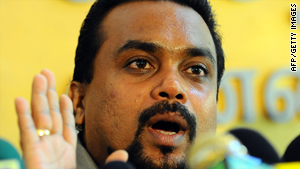
A Sri Lanka Cabinet minister began a "fast unto death" outside the United Nations compound in Colombo on Thursday to demand that the organization stop its investigation into alleged war crimes.
Wimal Weerawansa, the construction minister, told reporters he would fast until U.N. Secretary General Ban Ki-moon dissolves a panel made up of an Indonesian, a South African and an American.
Ban appointed the three-member panel to advise him on violation of human rights and related issues when Tamil Tiger rebels were militarily defeated in May last year. The move is prelude to a war crimes inquiry.
The United Nations has been concerned about accountability issues related to the military defeat of the rebels, including alleged war crimes by troops and rebels -- allegations that both parties deny.
"Ban's move is intended to bring President Mahinda Rajapaksa before a war crimes tribunal. We will not allow that to happen," Weerawansa told a news conference earlier in the week.
Nearly a hundred of Weerawansa supporters gathered Thursday morning outside the U.N. compound. The entrance to the complex was open, however, as some staff went about their work.
In New York, the U.N. associate spokesman Farhan Haq said Ban's chief of staff, Vijay Nambiar, met with Sri Lanka's ambassador to the United Nations, Palitha Kohona, who gave "full and clear" assurances of U.N. staff safety and security.
He added that Weerawansa said U.N. staff would be allowed to move in and out of the compound.
"We trust that the government of Sri Lanka will honor the commitments made in ensuring the safety and security of our staff so that they can continue the vital work being carried out by the United Nations each day to help the people of Sri Lanka," Haq told reporters in New York.
The U.N. Country Team (UNCT) confirmed that essential staff will return to normal work starting Friday.
"However, as there are some indications of demonstrators remaining outside the compound, the UNCT will assess whether all staff could return soon," Haq said.
Opposition leader Ranil Wickremasing urged the government to make a statement on how a minister ended up staging demonstrations.
"Today, Sri Lanka is on the verge of being labeled as an international fugitive facing the risk of being hauled up before the International Criminal Court," Rajapaksa's one time foreign minister and now an opposition MP, Mangala Samaraweera, told parliament.
The two English morning national newspapers also criticized the move.
The Daily Mirror said in an editorial "after all this drama the government issued one of its silliest statements ever" justifying the siege as a "peaceful demonstration."
The Island newspaper said Weerawansa and his supporters "must be condemned unreservedly for their abortive bid to hold U.N. staff incommunicado."
[Feedback] Feedback Share this on: Mixx Facebook Twitter Digg delicious reddit MySpace StumbleUpon LinkedIn Viadeo Protesters lay siege to U.N. compo
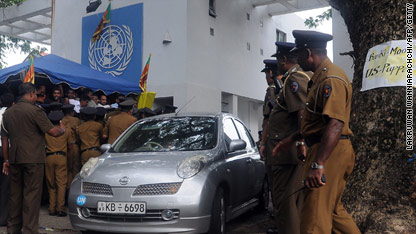
Protesters led by a Sri Lankan cabinet minister laid siege to the United Nations compound in Colombo on Tuesday, demanding that the world body drop a probe into alleged human rights abuses in the final stages of the separatist war that ended last year.
Staffers were prevented from leaving as a crowd of about 1,000 surrounded the compound and burned an effigy of U.N. Secretary-General Ban Ki-moon. Their placards told the United Nations to stop interfering in Sri Lanka's affairs.
Ban named a three-person advisory panel last month to look into possible human rights violations committed during the war between the government and the Liberation Tigers of Tamil Eelam.
"The secretary-general remains convinced that accountability is an essential foundation for durable peace and reconciliation in Sri Lanka," a statement from Ban's office said. "Through the panel, the secretary-general expects to enable the United Nations to make a constructive contribution in this regard.
Scuffles erupted Tuesday when U.N. staff tried to leave the compound.
Police charged the crowd with batons, wounding at least six people. Wimal Weerawansa, a minister in President Mahinda Rajapaksa's government, said the protesters planned to return Wednesday.
The United Nations objected to the demonstration led by Weerawansa.
"While respecting the right of citizens to demonstrate peacefully, preventing access to U.N. offices hinders the vital work being carried out by the United Nations each day to help the people of Sri Lanka," U.N. spokesperson Farhan Haq told reporters in New York.
"The government has provided assurances for the safety and security of our staff and for their full access to their offices," he added. "We will be closely monitoring developments and trust these commitments will be honored."
Sri Lanka's decades-long war, through which the Tamil Tigers were seeking an independent homeland, ended with a ceasefire in May 2009. More than 65,000 people died in the strife.
The United Nations has been concerned about accountability issues related to the military defeat of the rebels, including alleged war crimes by troops and rebels -- allegations that both parties deny.