Showing posts with label business. Show all posts
US economic growth slows to 2.4%

US economic growth slowed between April and June, with GDP growing by an annualised rate of 2.4%, the US Commerce Department has said.
This compares with an annual rate of 3.7% in the previous quarter.
The second quarter figure is a first estimate, and could be revised either up or down in the coming months.
There are growing fears about the strength of the US economic recovery, particularly concerning the country's high unemployment rate of 9.5%.
Despite the slower rate of growth, economic adviser to the White House Christine Romer said: "This solid rate of growth indicates that the process of steady recovery from the recession continues.
"Nevertheless, faster growth is needed to bring about substantial reductions in unemployment."
Upward revision
Mardell's America
Continue reading the main story
“Start Quote
About 200 people come through the doors of Philadelphia's City Hall every day and Judge Annette Rizzo says it is like a petri dish where the development of the city's economy can be examined in minute detail”
End Quote
Mark Mardell BBC North America editor
* Read Mark's thoughts in full
A large increase in imports and a fall in sales of goods such as cars partly explain the slowdown in GDP growth, while personal consumption grew at a slower rate than in the first quarter.
These factors more than offset an increase in spending on property construction, as Americans looked to take advantage of tax credits for home buyers that expired during the quarter.
The Commerce Department also revised its previous estimate for growth in the first three months of the year up sharply, from 2.7% to 3.7%.
"The economy entered the second quarter with plenty of momentum, but exited with very little," said Nigel Gault, chief US economist at IHS Global Insight.
The US economy has now grown for four straight quarters.
'Weakening environment'
The second quarter GDP growth figure was slightly lower than analysts' expectations.
US GDP
As a result, the main Dow Jones index fell more than 100 points in early trading, before swiftly recovering to 10,427.57, 40 points down on the day.
"This number will cast a pall on today's trading," said Jack Ablin at Harris Private Bank.
He also expressed commonly-held fears that growth could slow further as government stimulus measures are withdrawn.
"My sense is that we're operating in a weakening environment without the help of a lot of stimulus. If the stimulus package was a box of doughnuts dumped on the economy, we only have one or two doughnuts left in the box."
The US pumped hundreds of billions of dollars into the economy during the downturn to try to stimulate demand.
Earlier on Friday, the International Monetary Fund (IMF) said that the US might have to increase its stimulus spending to support the recovery.
It said the US "economic recovery has been slow by historical standards" and warned that "the outlook remains uncertain".
"Thanks to a massive policy response to the worst financial crisis since the Great Depression, the US economy is recovering, but further decisive policy action will be needed to address the policy challenges stemming from the crisis," the IMF warned.
Citigroup agrees $75m fraud fine

Banking giant Citigroup has agreed to pay $75m (£48m) to settle civil charges that it misled investors over potential losses from high-risk mortgages.
It agreed the settlement with US financial watchdog the Securities and Exchange Commission (SEC).
The SEC said Citigroup had repeatedly made misleading statements about the extent of its exposure to subprime loans as the housing market slumped.
Earlier this month, Goldman Sachs agreed also settled civil charges.
Big Banking
* Q&A: What is a stress test?
* Q&A: US bank regulation
* Q&A: UK bank curbs
* UBS profits ahead of expectations
Those charges concerned Goldman's marketing of mortgage investments as the US housing market faltered. Its $550m fine was the biggest the SEC had imposed on a bank.
'No half-truths'
Citigroup had said in 2007 that its exposure was $13bn or less. The SEC said it exceeded $50bn.
SEC Enforcement Director Robert Khuzami said Citigroup had misled analysts and the market of its ability to reduce its subprime exposure.
"In fact, billions more in... subprime exposure sat on its books undisclosed to investors," Mr Khuzami said.
"The rules of financial disclosure are simple - if you choose to speak, speak in full and not in half-truths."
Citigroup struggled during the financial crisis and received among the largest bailouts from the US government.
Of the $45bn it received, $25bn was converted to a government ownership stake last summer, with the remainder being repaid.
The $75m fine will not make much of a dent in bank's balance sheet. It earned $2.7bn in the three months to the end of June.
Citi said it was pleased to have reached agreement with the SEC and that neither the bank not any individuals had been charged with "intentional or reckless misconduct".
Boeing profits slump by a fifth as deliveries fall

Aircraft giant Boeing has reported a sharp drop in profits between April and June amid falling plane deliveries.
Net profit for the quarter was $787m (£504m), higher than analysts had expected but down 21% on the $998m the firm made in the same period last year.
Group revenue also fell, to $15.6bn from $17.2bn a year earlier.
However, the company said its commercial markets were recovering and it remained "well positioned for growth in 2011 and beyond".
Aerospace and Defence
* In pictures: Farnborough air show
* Typhoon versus the F-35
* Engine contracts up for grabs
* The economics of aircraft cabins
"Continued strong results from our major businesses drove another solid quarter of operational performance for the company," said Boeing's chairman Jim McNerney.
However the firm delivered only 114 commercial aircraft during second quarter, down from 125 a year earlier.
Across the first six months of 2010, deliveries fell to 222, down 10% from 2009.
Dreamliner
Boeing enjoyed a successful Farnborough air show this month, particularly on the commercial side of the business.
It received a $9.1bn (£5.9bn) order from Emirates for 30 of its 777 aircraft, and confirmed a deal with RBS Aviation Capital for 43 of its 737 aircraft.
The firm also has high hopes for its new 787 Dreamliner, the first of which is due to be delivered to Japan's All Nippon Airways at the end of this year, although Boeing recently said this date could slip into next year.
The project has been delayed for more than two years following a series of hitches.
The Dreamliner is Boeing's most sophisticated plane yet. The company claims it will be lighter, faster and emit less carbon dioxide than similar-sized planes currently flying.
However the outlook for the defence side of Boeing's business is less clear.
Governments around the world are making budget cuts in order to reduce debt levels, which means spending on defence is likely to fall sharply.
JP Morgan profits jump in second quarter

JP Morgan experienced strong growth in profits in the second quarter, thanks largely to falling loan losses.
The US bank booked net income of $4.8bn (£3.1bn), up from $2.7bn in the same period last year, a rise of more than 75%.
The bulk of the $2.1bn improvement came courtesy of a $1.5bn reduction in the amount of money the bank has set aside for possible loan losses.
JP Morgan's share price fell 1.5% in early trading, in spite of the profits.
Bank stocks were hit by poor economic news from the US.
The Manhattan-based bank also said it incurred a charge of $550m for the quarter, to cover the UK's new 50% bonus tax.
JP MORGAN CHASE & CO.
Last Updated at 15 Jul 2010, 18:33 GMT
*Chart shows local time
price change %
40.24 - -0.11 - -0.27
More data on this share price
Windfall
The reduction in the money reserved for potential loan losses is effectively a windfall gain to profits. This reduction, or release, could be the first of many, analysts say.
"The thing you have to remember is that total reserves are still some $36bn, so I think we could be looking at a series of 'one-off' releases," said Moshe Orenburg, financial stock analyst at Credit Suisse.
"We're talking about $10-20bn in total," he added, on the assumption that the economy continues its recovery.
He also points out that most of the reserve release in the last quarter related to the bank's credit card business rather than its home loan business, reflecting chief executive Jamie Dimon's self-professed nervousness about the housing market.
And Mr Orenbuch is upbeat about JP Morgan's ability to weather a possible second downturn in the housing market in the second half of the year.
Summary of second quarter results
Continue reading the main story Total net income: $4.8bn
Change on a year earlier: +$2.1bn (76%)
Reduction in loan losses: $1.5bn
Cost of UK bonus tax: $550m
Investment bank net income: $1.4bn (-$90m)
Retail services net income: $1bn (+$1bn)
Credit cards net income: $30m (+$1bn)
Weak trading profits
JP Morgan's investment bank raked in $1.4bn, slightly down on 2009, as revenues fell 13%.
The weak trading profits were not unexpected, according to Mr Orenbuch at Credit Suisse.
Last year, most of the US lender's profits were brought in by its the capital markets business in its investment banking unit, which includes trading in shares and bonds.
However, the second quarter proved more challenging, as markets fell heavily for the first time since the financial crisis on fears over European sovereign debt and a possible double-dip recession.
Now, thanks to a remarkable turnaround in credit losses, it is the Wall Street firm's retail services business, which does traditional deposit-taking and mortgage lending, that is taking the lead.
It swung into a $1bn profit during the quarter, up from about zero a year ago, and comparable with the kind of money made by JP Morgan's investment bank.
Continue reading the main story
“
Start Quote
These businesses did not meet expectations”
End Quote
Jamie Dimon
Chief executive, JP Morgan
The bank's credit card business also began turning a healthy profit, of $343m, versus a loss of nearly $700m a year ago - a $1bn turnaround.
Loan repayments
However, in both units underlying revenues actually fell slightly, indicative of JP Morgan scaling back its consumer lending business.
All of the improvement in profits instead came from the fact that, with the economy improving, the bank no longer needed to set so much of its revenues on one side to cover losses on bad loans.
JP Morgan reported that the rate at which it had to write down loans because of non-payments had fallen sharply.
On sub-prime loans - the riskiest home loans - this loss rate stood at 8.6%, down from 13.4% only three months earlier.
'Not satisfactory'
But despite this turnaround, the bank thinks that the two units still have some way to go.
"Although we are gratified to see consumer lending net charge-offs and delinquencies decline, they remain at extremely high levels," said JP Morgan's chief executive, Jamie Dimon.
"As a result, these businesses did not meet expectations nor generate satisfactory returns on capital for our shareholders," he added. "It is too early to say how much improvement we will see from here."
In total, the reduction in credit losses across the entire bank improved its bottom line by $6.3bn compared with a year ago.
That figure includes the $1.5bn gain from the bank's decision to reduce the amount of money it holds in provision against losses.
However, most of this $6.3bn gain from lower credit losses was offset by falling revenues and higher staff and administration costs, meaning profits actually only rose by $2.1bn.
Where and when
Many analysts questioned Mr Dimon about the likely impact of a raft of strict new banking regulations being introduced in the US.
The chief executive would however not be drawn on the subject on a conference call following the release of the quarterly report.
Mr Orenbuch at Credit Suisse says it is a question of both where and when the cost of the reform will come.
"We think it will hurt a lot more in retail [lending business] than in wholesale," he says, noting the strict new legislation affecting deposit insurance, overdraft protection and credit cards.
He reckons that ultimately around 10% of JP Morgan's projected 2012 income could be hit.
"But the timeframe is unknown," he adds. "We are certainly talking several years hence."
EU backs BA and American Airlines alliance

European regulators have paved the way for British Airways, Iberia and American Airlines to work together.
The EU Commission said it would give BA and Iberia immunity from anti-trust laws that prevent businesses from co-ordinating prices and schedules.
Under the plan - which still needs US backing - the airlines would share costs, but give up four transatlantic take-off and landing slots.
The regulators also approved BA's merger with Spain's Iberia.
That deal - to create Europe's third-largest carrier - is aimed at helping both carriers cut costs as the industry struggles to make money.
The new company will be called International Airlines Group, but the BA and Iberia brands will continue to operate as normal.
The approval for the BA and Iberia merger had been expected The European Commission said it did not have any anti-competition concerns over the merger because the enlarged airline would continue to face competition from rivals, even on routes such as London-Madrid and London-Barcelona.
When the merger was confirmed, BA said the group would operate 419 aircraft, flying to more than 200 destinations, and carry a total of 62 million passengers a year.
'Monster monopoly'
Virgin Atlantic has been vocal in its opposition to the deal between BA and American Airlines. Its boss, Sir Richard Branson, said consumers would lose out.
"We have fought this monster monopoly for the past 13 years and are still resolute in our belief that this decision is shameful and consumers will suffer greatly as a result of this deal," he said.
BA has argued that closer co-operation between the airlines will benefit passengers with more choice and lower fares.
It plans to begin the transatlantic business from the autumn, provided it gets clearance from the US Department of Transport.
"We await the DOT's final decision, but welcome this important and vital step forward," said BA chief executive Willie Walsh.
He added that the move to make some of its Heathrow slots available to competitors was a "pragmatic decision so that we can get the joint business up and running as soon as possible".
"The slot commitments provide a further guarantee that there will be no possible loss of competition as a result of our joint business," he added.
Commission welcomes Unicredit bank rescue fund proposal

The European Commission has cautiously welcomed a financial rescue fund being proposed by Unicredit.
The Italian bank wants to set up the 20bn-euro ($25bn; £17bn) fund as a private initiative by Europe's big banks to help finance any future bail-out.
Internal Market Commissioner, Michel Barnier, said he found the plan "quite encouraging".
But he said it should be broadened to include the wider financial system.
Unicredit's head, Alessandro Profumo, is said to be discussing his idea with his counterparts at other big European banks, including Deutsche Bank, Banco Santander and BNP Paribas.
Pre-emption strategy?
It is unclear at this stage what the thinking behind Unicredit's proposal is.
The Italian bank may be trying to pre-empt Mr Barnier's own plans But it could be intended to pre-empt similar proposals being pushed by Mr Barnier himself.
The commissioner wants a new European law next year that would require governments to set up national resolution funds to cover future bail-out costs.
These national funds would be financed by an obligatory levy on financial institutions.
Some bankers, including Deutsche Bank's head, Josef Ackermann, have expressed doubts as to whether they could afford this levy.
Size matters
However, at 20bn euros, the total size of Unicredit's alternative proposal is relatively small.
The cost of recapitalising RBS alone was £37bn in 2008, more than twice the size of the entire fund.
It is certainly a lot smaller than the network of funds planned by Brussels.
Commissioner Barnier has made clear that his proposal would be big enough to ensure the entire cost of future bailouts is covered by the financial sector, instead of taxpayers.
Toyota working on Tesla-based electric car
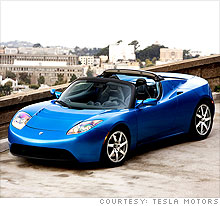
Moving ahead with a partnership announced in May, Toyota is working on a potential new electric car with California's Tesla Motors, a source at the Japanese automaker said.
Toyota Motor Co. chief executive Akio Toyoda was quoted in media reports from Japan saying that Toyota was working on a prototype electric vehicle based on Tesla's technology. An internal Toyota briefing document obtained by CNNMoney.com confirmed those reports.
Toyota is working Tesla Motors, maker of the Tesla Roadster electric sports car pictured here, to build a new electric vehicle.
It is unclear, however, how far such a vehicle is in development. Toyoda reportedly said details of the program would be released later.
Toyota announced in May that it planned to invest $50 million in Tesla Motors following the electric car maker's initial public offering, which took place on June 29.
Toyota, which is already the industry leader in gas-electric hybrid cars, is also looking for other partners to develop future alternative fuel technologies. Collaboration will be an important part of Toyota's alternative fuel strategy, Toyoda said, according to the document.
Toyota executives have, in the past, expressed doubts about the market potential for purely electric cars, citing their high cost, relatively short driving distance, long charging times and questions about battery technology.
Last year, Toyota revealed a concept version of a tiny electric "city car" with a 40 mile range. That car is under development, Toyota said at the time, and is intended primarily for short-term rental use within cities.
That car, the FT-EV II, illustrated an ideal real-world use for an electric vehicles, Toyota executives said at the time. The Tesla project is apparently a separate project.
Toyota plans to introduce a plug-in version of the Toyota Prius hybrid car in 2011, but that vehicle would still use a gasoline engine as its primary power source.
BP in new attempt to plug Gulf of Mexico oil leak

The BBC's Madeleine Morris says it may take days to complete the operation
BP has begun an operation to fit a tighter cap over its blown-out oil well in the Gulf of Mexico.
An underwater robot has taken off the existing dome to make room for the new sealing cap.
But the operation may last between four and seven days - meaning oil will flow unimpeded into the sea.
Another system is also being linked up and may start collecting crude on Sunday, BP says. It is drilling two wells to intercept and block the leak.
It estimates the first of these wells will be finished in the first half of August, enabling the company to intercept fully the damaged well.
The explosion of the Deepwater Horizon rig in April killed 11 people. President Barack Obama has called the leak the biggest environmental disaster in US history.
Increased potential
BP's submersible robots have removed the current containment cap from the ocean floor, but now it will be several days at best before the new cap is in place.
A fleet of 400 skimmers is in place to try to minimise the effects of increased oil loss during the operation, BP said.
"It's not just going to be, you put the cap on, it's done. It's not like putting a cap on a tube of toothpaste," Coast Guard spokesman Capt James McPherson warned.
The president says this is the biggest environmental disaster in US history The new sealing cap - similar to a smaller version of the damaged blow-out preventer - has three devices that are designed to shut the flow.
According to BP, the new cap "creates the potential to increase oil and gas containment capacity to greater than 50,000 barrels per day and should improve containment efficiency during hurricane season by allowing shorter disconnect and reconnect times".
The company said that "there can be no assurance that the sealing cap will be successfully installed or installed within the anticipated timeframe", given it has never been attempted at this depth before.
It said that contingency caps were at the ready on the seabed should the replacement operation fail.
The company also said that favourable weather conditions had made it possible to begin another operation in tandem - connecting a new ship to the blow-out preventer.
The ship is known as the Helix Producer and it will begin collecting oil and sending it to a third ship being used for the purpose.
BP says this could begin "ramping up containment operations as early as Sunday".
The containment dome currently collects about half the amount of oil gushing out of the damaged well.
On Friday, the Coast Guard commander overseeing the response, Adm Thad Allen, said the flow of leaking oil could be contained by Monday. But in that time hundreds of thousands of barrels of oil could flow unabated into the ocean.
"We have a significant chance to dramatically reduce the oil that's being released into the environment and maybe shut the well in altogether in the next week," he said.
"I use the word 'contained'," said Adm Allen. "'Stop' is when we put the plug in down below."
At the moment it is believed that BP is siphoning off only around half the leaking oil.
Current US government estimates of the spill range from between 35,000 to 60,000 barrels a day.
On Thursday BP said its operation to drill a new relief well to stop the Deepwater Horizon leak was ahead of schedule.
BP's bill so far has been more than $3.1bn - and it has agreed to set up a $20bn fund to deal with compensation claims and clean-up costs.
Boeing submits new bid for USAF refuelling contract

Boeing has submitted its fresh bid to supply refuelling aircraft for the US Air Force.
It comes a day after arch-rival EADS delivered its attempt to win the contract to the Pentagon.
The contract, which has been long delayed, is worth $35bn (£23bn).
Earlier this week, a World Trade Organisation (WTO) investigation into whether Boeing receives illegal subsidies from the US government postponed its decision on the matter.
Both the US and the European Union have reported each other's companies to the WTO, alleging illegal subsidies.
The WTO ruled at the end of June that the EU had paid illegal subsidies to the EADS subsidiary, Airbus.
The EU and Airbus criticised the delay over the Boeing decision.
Political decision
Boeing is struggling due to the major delays faced in the introduction of its 787 Dreamliner.
The firm said that its hand-delivered proposal would offer a US-made tanker, based on its 767 planes, meeting all Air Force requirements at the lowest cost to the taxpayer.
It added 50,000 jobs and 8,000 suppliers would be supported if it won the contract, adding it was the "only company in this competition with rich experience in developing and manufacturing derivative aircraft for the warfighter".
The US hopes to have chosen a winner by November.
It is replacing its current fleet of tankers, some of which date back to the late-1950s.
Several previous attempts to choose a contractor have failed - one because of a dispute between Boeing and its then-rival Northrop Grumman.
The decision is highly political and although EADS plans to build its craft within the US, it is seen as very much a European business.
IMF raises global economic growth forecast

The International Monetary Fund (IMF) has raised its forecast for global economic growth this year, from 4.2% to 4.6%.
It said the world economy grew strongly in the first part of this year, mainly due to robust growth in Asia.
Developed economies maintained a modest but steady recovery in the same period.
But it warned risks had increased and there had been a setback in progress towards financial stability.
Debt concerns
Concerns over the sustainability of government finances in the developed world, especially Greece and others in Europe, were the major threat to global recovery the agency argued.
It said governments should focus on improving their finances, but warned them not to make cutbacks too rapidly.
In recent weeks, a number of governments have introduced austerity measures to cut deficit levels.
The IMF said that European banks in particular were being affected by the concerns about government debt and so were less wiling to lend to each other. Less credit available to the wider economy could undermine the recovery, it argued.
Although contagion to other regions of the world was likely to be limited, there was a risk that Europe's troubles could have a more substantial impact on global economic growth, it said.
Why Google is not feeling lucky
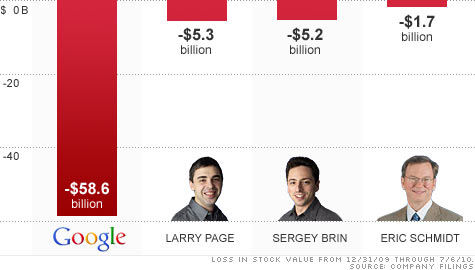
Perhaps it's time for Google to be evil.
Shares of the Internet advertising giant had fallen for 13 consecutive trading sessions before finally rallying Wednesday. During that unlucky stretch, Google's stock plunged (coincidentally?) 13%, erasing about $20.8 billion in market value.
330
diggs
diggEmail Print Comment
Google's stock has taken a tumble this year as momentum investors seem to favor Apple instead.
The stock rose more than 3% Wednesday along with the broader market. That was despite a price target cut by J.P. Morgan analyst Imran Khan.
But even though Google (GOOG, Fortune 500) broke its losing streak, the recent rough patch is just the latest in what's been an awful year for the stock. Google's down nearly 30% in 2010, worse than the drops experienced by top rivals Microsoft (MSFT, Fortune 500) and Yahoo (YHOO, Fortune 500).
Even though Google remains the undisputed king in online search, investors seem bored with Google's dominance. The company's troubles in China have some concerned that Google will never be able to extend its market share lead in the U.S. to the world's largest market.
Shares of Baidu, Google's main competitor in China, have surged more than 65% so far in 2010 as investors bet that Google's battle with the Chinese government over censorship will make Baidu (BIDU) even stronger.
It's also looking more and more like Google, despite all its efforts to diversify, may be a one-trick pony after all. Sure, that pony is hardly a nag. As I wrote way back in 2005, it was performing like Secretariat.
0:00 /1:00Google blinks in China dispute
That's still the case. Google will report its second quarter results on July 15. Analysts expect that Google's sales (excluding ad revenue shared with partners) and earnings per share will surge more than 22% from a year ago. For the full year, analysts are predicting an earnings increase of about 20%.
That's obviously an enviable growth rate in an economy that's still tepid at best. Still, Google is a victim of its success. Over the past five years, Google's annual earnings growth rate has averaged nearly 40%.
Growth inevitably has to slow given how large the company has become. But Tim Boyd, an analyst with MKM Partners in Stamford, Conn., said that Google's slowing momentum could be enough of a reason to convince some growth-oriented institutional investors to sell the stock.
"Google has been criticized for years for not diversifying, but as long as it was growing at 30% to 40% nobody cared," he said. "Now with growth slowing to 15% to 20% or so, that puts you at the cusp of being a value stock."
Some investors are also worried that Google has not been able to replicate its market dominance in other areas -- most notably, in the world of mobile devices and social networking.
"Google's core business of search is still doing well, but people need to know what the next big multibillion dollar product will be. That's spooking investors," said Sameet Sinha, an analyst with JMP Securities in San Francisco.
Stay on top of Google 24/7 with Fortune's Google blog
Google has made a mild splash with its Android mobile operating system and Nexus One phone. But that's nothing compared to the cannonball that is Apple.
Unfortunately for Google, beating the stuffing out of Yahoo and Microsoft in search is now considered a fait accompli. But Apple (AAPL, Fortune 500), with its iPhone and iPad, has become more of a competitor to Google as of late. And Google's growth, while impressive, is pedestrian when compared to Apple.
Analysts expect Apple to report a profit jump of more than 50% in its fiscal third quarter (which ended in June) and a nearly 75% sales increase. For the full fiscal year ending in September, analysts are forecasting a profit increase of over 50%.
So it's no wonder that Apple's stock has held up during the market turmoil of 2010: Shares are up nearly 20% so far this year.
"It seems like we say it every quarter, but there's not a lot new to get excited about with Google. It's steady as she goes," said Martin Pyykkonen, an analyst with Janco Partners in Denver. "With other growth stocks like Apple, there are obvious catalysts for investors."
Pyykkonen said that recent moves, such as Google's $700 million acquisition of online travel software firm ITA, are just "a drop in the bucket" for a company of Google's heft.
One also gets the distinct impression that if Facebook ever decides to file for an initial public offering, the social networking juggernaut would immediately whip investors into a frenzy -- the type of which not seen since Google's IPO in 2004.
(Whether or not social networking sites like Facebook and Twitter will ever be able to generate as much revenue and profit as Google is a topic of debate for another time.)
Still, from the standpoint of investors, Google may not have to become as sexy as Apple or Facebook. It just needs to keep doing what it's doing in search and generate more revenue from other forms of online ads.
Sinha said that Google is already positioned well in the so-called display market, selling graphical ads that aren't just contextual search links. Video ads in particular could be a big business, thanks to Google's YouTube site, Sinha said.
Shares now trade at just 16 times 2010 earnings estimates. That's about in line with the so-called earnings multiple for the broader market.
Boyd said that's a very good value considering that Google has a pristine balance sheet and has been fending off challenges from Yahoo and Microsoft's Bing in search.
"The stock is now trading as if it's losing market share. It doesn't make sense," he said.
- The opinions expressed in this commentary are solely those of Paul R. La Monica. Other than Time Warner, the parent of CNNMoney.com, La Monica does not own positions in any individual stocks.
China bank on course for record $22.1B IPO

Agricultural Bank of China is set to raise up to $22.1bn in the world's biggest initial public offering, underscoring the strength of investor faith in the growth of the Chinese economy.
AgBank, the last of China's big state-owned banks to go public, has managed to complete its offering during a period in which global markets have tumbled and dozens of IPOs have been scrapped.
The deal highlights investor optimism about Chinese banks, even as their peers in the west are hobbled by bad loans after the financial crisis.
Investors are also betting that state entities in China will stand behind the politically important listing to ensure its success, at least in the short term.
However, there are fears that the shares could fall on their debut in Hong Kong and Shanghai next week after the shares were priced last night towards the top of the ranges at which they had been marketed to investors.
AgBank has raised a total of $10.4bn in Hong Kong and $8.8bn in Shanghai, totalling $19.2bn. A greenshoe option to boost the size of the offering by 15 per cent would expand the proceeds to $22.1bn, making it the largest IPO ever.
Given the demand for the offering -- the shares were more than 10 times subscribed in Hong Kong and more than 20 times in Shanghai -- bankers say that the green shoe is likely to be exercised.
AgBank would like to see its listing exceed the record $21.9bn that Industrial and Commercial Bank of China (ICBC) raised in 2006, according to people close to the deal.
AgBank was the last of China's large banks to be recapitalised in preparation for an IPO and it is generally viewed in China as the weakest of the top lenders.
But investors have backed the IPO on the basis that AgBank, which has 24,000 branches, mainly in rural areas, and 320m retail customers, is well positioned to benefit from growth.
Some investors have resisted buying into the IPO in the belief that the shares were not priced at a steep enough discount to AgBank's stronger peers, ICBC and China Construction Bank.
There are also fears that Chinese banks will suffer a rise in bad loans in the coming years following an unprecedented lending spree in 2009 and 2010.
All of China's large banks have announced plans to raise tens of billions of dollars to meet stricter regulatory requirements and replenish capital. The listing of AgBank brings to a close an era of huge reform of the country's large lenders, a process that has taken a decade.
The banks have now largely been put on a commercial footing and its executives expected to run the companies at a profit.
However, the ruling communist party retains absolute control over the appointments of top executives, giving top leaders the power to step in to direct lending when they see fit.
AgBank sold 25.4bn shares in Hong Kong at HK$3.20 each, compared with an original range of HK$2.88-HK$3.48. The bank also sold 22.24bn shares in Shanghai at Rbm2.68 each, the top of its range.